The 1944 quarter value starts with silver. The coin belongs to the wartime part of the Washington quarter series. It is a 90% silver issue, circulated during World War II. It still has a clear place in both silver stacks and date-and-mint collections. That gives it real appeal. It does not make the date rare by itself.
The 1944 quarter is special in history and metal content. It is not special as a key date in the same way as the famous low-mintage Washington quarters. To judge it properly, you need to look at silver content, mintmark, condition, and varieties.
The 1944 Quarter Overview
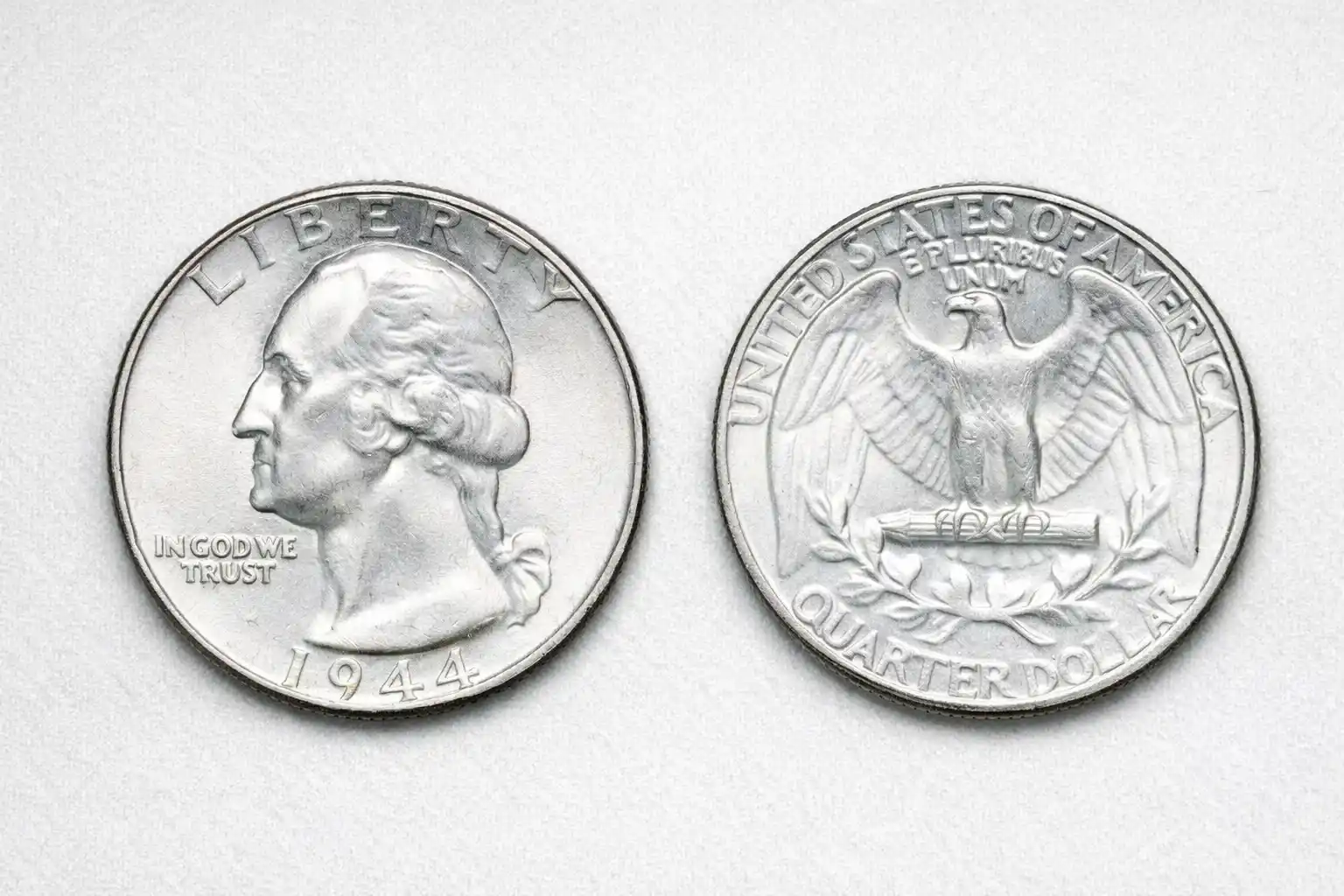
The 1944 quarter is a regular-issue Washington quarter with the standard eagle reverse. The basic specifications are in the table below.
By the way, regular proof coinage had been suspended after 1942 and did not return until 1950, so there is no normal 1944 proof quarter to compare with.
| Parameter | 1944 Quarter |
| Coin Type | Washington quarter |
| Composition | 90% silver, 10% copper |
| Diameter | 24.30 mm |
| Weight | about 6.30 grams |
| Edge | Reeded |
| Proof Version | No regular 1944 proof |
These basics matter because they explain the two main value layers. First, every normal 1944 quarter has silver value. Second, all collector premiums must come from grade, eye appeal, mintmark demand, or varieties, not from a proof format that does not exist for the year.
Why 1944 Feels Special
The year 1944 sits deep inside the World War II period. That gives the coin a context many collectors like. It is part of the wartime silver stream that moved through the American economy while proof coinage was suspended and Mint priorities were shaped by wartime demand. That historical setting is real. It helps explain why many collectors treat the coin as more than a generic pre-1965 quarter.
Still, history and rarity are not the same thing. The 1944 quarter is a wartime silver coin, but it is not a scarce date in ordinary grades. Philadelphia alone struck 104,956,000 pieces. Denver struck 14,600,800. San Francisco struck 12,560,000. Those are healthy numbers. The market has plenty of normal survivors.
Is 1944 Special as a Date?
Not really. It is special as a wartime silver issue. It is not special as a rare date by itself. That distinction matters because many collectors see “1944” and expect something scarcer than the market actually offers. In lower grades, the coin is mostly a silver quarter with a modest collector premium. In higher grades, the story changes.
What makes 1944 interesting:
- World War II context
- 90% silver composition
- Classic Washington quarter design
- Steady demand for pre-1965 silver quarters
What does not make it special by itself:
- It is not a key low-mintage date
- It is not a proof year
- Normal examples survive in large numbers
Mintmarks, Mintages, and Basic Market Levels
The three regular issues behave a little differently, but not as much as new collectors often expect. Philadelphia is the common baseline. Denver has a lower mintage and becomes more interesting in stronger grades. San Francisco also has a lower mintage, yet that alone does not make it dramatically scarcer in ordinary collector terms.
| Version | Approximate Mintage | Typical Price Range for Common Collectible Examples | Main Note |
| 1944 | 104,956,000 | about $15–$44 | Common date, value starts with silver, and condition |
| 1944-D | 14,600,800 | about $16–$57 | Lower mintage, stronger interest in better grades |
| 1944-S | 12,560,000 | about $15–$49 | Lower mintage, but not automatically scarcer in normal market use |
These ranges combine average-condition and uncirculated guide levels. They describe common collectible examples, not elite registry coins. That is why the numbers stay moderate for a long stretch.
Silver Value vs Collector Value
This coin always lives on two levels. The first level is metal. The second is numismatic quality. A worn 1944 quarter may trade mainly as a silver coin. A sharp Mint State example trades as a collector coin. A listed variety or a major error enters a third tier.
That is why ordinary prices stay fairly calm from worn grades into lower Mint State. The silver floor does much of the work at the low end. Once the coin reaches better uncirculated quality, the market starts paying for luster, cleaner fields, and scarcity in top grades.
Value Overview by Grade
The value curve is not flat, but it is not dramatic at first either. Many 1944 quarters remain affordable through circulated and lower Mint State levels. The strong jump comes late. That is typical for a widely saved silver type with very large total survival.
| Grade Level | 1944 | 1944-D | 1944-S | Market Reading |
| Circulated (G–VF) | about $15–$23 | about $16–$23 | about $15–$23 | Mostly silver floor plus a small premium |
| XF–AU | about $23–$25 | about $23–$25 | about $23–$24 | Better collector appeal, still moderate |
| MS63 | about $26 | about $32 | about $34 | Entry Mint State level |
| MS65 | about $32 | about $39 | about $41 | Stronger collector demand |
| MS66 | about $44 | about $61 | about $65 | Noticeable premium for quality |
| MS67 and higher | starts to separate sharply | better-grade premium rises | better-grade premium rises | Scarcity in quality matters more than date |
| MS68 / top-pop range | up to $16,800 | up to $10,575 | up to $16,100 | Elite certified market only |
The lower rows in that table come from guide levels. The top-pop row comes from real auction records. PCGS lists auction highs of $16,800 for 1944 in MS68, $10,575 for 1944-D in MS68, and $16,100 for 1944-S in MS68 CAC. That is the clearest proof that quality, not the year alone, drives the big money.
Which Mint Is the Most Interesting?
Philadelphia is the foundation piece. It is the issue most collectors meet first. It is common. It carries the wartime silver appeal. It becomes expensive only when the grade rises high enough to matter.
Denver is often the more interesting middle ground. The mintage is much smaller than Philadelphia’s, and stronger Mint State pieces attract more attention. It is still not a rare date in ordinary grades, but it has a clearer upside in better-preserved condition.
San Francisco looks scarcer on paper because of the lower mintage, but the market does not treat every 1944-S as a prize. In normal grades, it stays close to the other two. The coin needs strong preservation or a real variety to separate.
What Makes One 1944 Quarter Worth Much More Than Another?
The answer is practical. The date stays the same. The surfaces do not. The grade does not. The variety status does not.
The main value drivers are:
- Silver content
- Preservation
- Original luster
- Cleaner fields
- Stronger Mint State grade
- Confirmed varieties or errors
- Certification at the top end
That is why two 1944 quarters can look close at first glance and still sell in completely different brackets. One may be a silver piece worth a little more than melt plus a small premium. The other may be a sharply preserved Mint State coin or a recognized variety with a much stronger market.
Key 1944 Quarter Errors and Varieties
Errors and varieties give the year a second layer of interest. This is where the 1944 quarter becomes more than a silver type coin. The important point is simple: mint-made traits matter. Post-mint damage does not.
Doubled Die Obverse (DDO)
This is the first variety to check. On a real DDO, collectors look for doubling on LIBERTY, the date 1944, and IN GOD WE TRUST.
The auction highs are very different: $360 for the 1944-D in MS66 and $18,400 for the 1944-S in MS63. That spread shows how strongly the market can react to a listed wartime variety.
Struck on 5-Cent Planchet
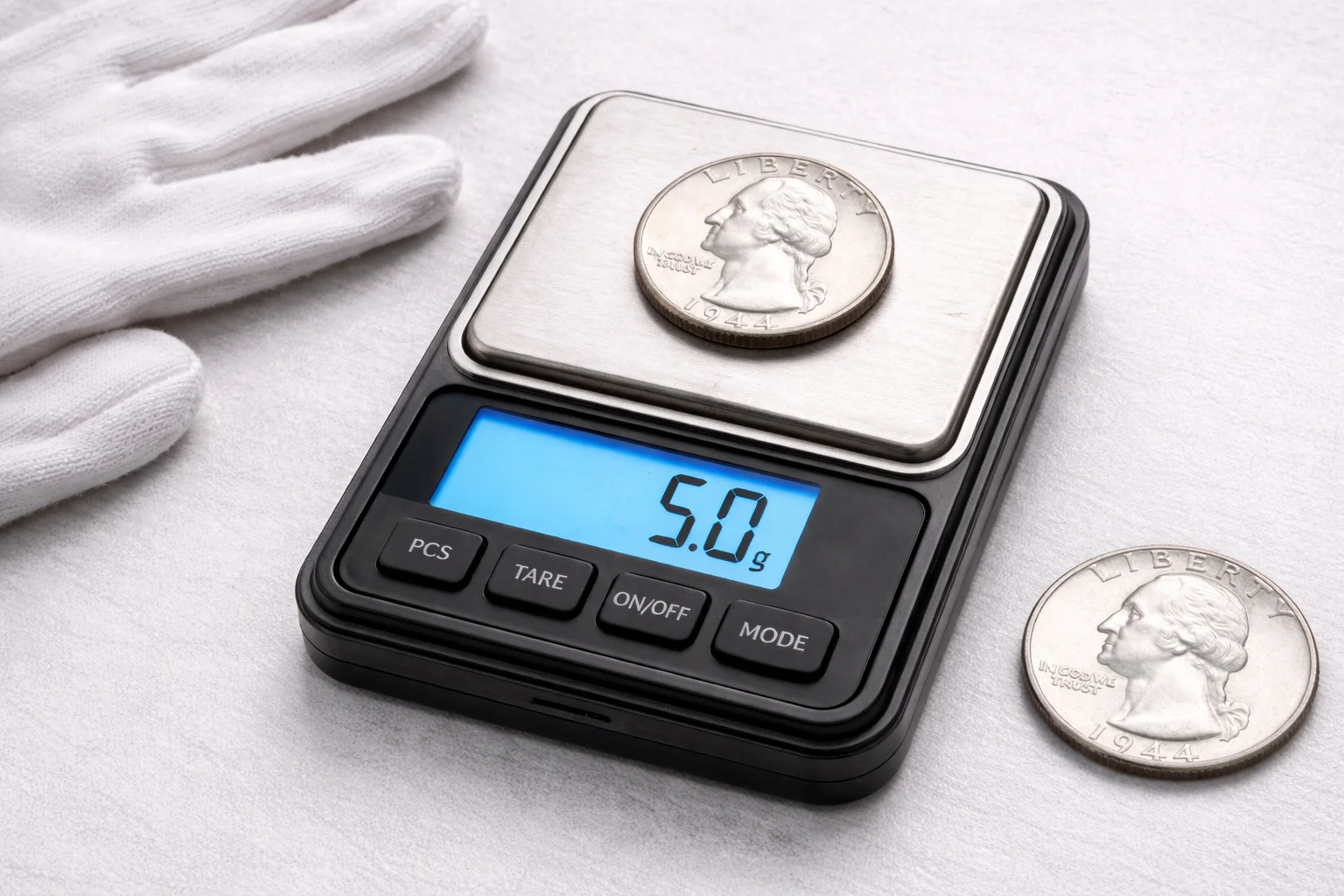
This is a major wrong-planchet error. The coin weighs 5.0 grams, not the normal quarter weight, because it was struck on a wartime nickel planchet. Heritage has sold a 1944 quarter on a five-cent planchet, and older records cited by Heritage show a realization of $2,990.
Another dealer-handled NGC MS62 example was listed as sold at $8,200. The safe conclusion is not that every such error brings one fixed number. The safe conclusion is that real examples are very rare and sell in the multi-thousand-dollar range.
Repunched Mint Mark (RPM)
RPMs are another area worth checking, especially on Denver and San Francisco pieces. Variety Vista lists multiple 1944-D RPMs and multiple 1944-S RPMs for Washington quarters.
That means the mintmark itself can carry extra interest when the secondary punch is clear. These are usually subtler than a strong DDO, but they are part of the year’s real variety profile.
Lamination Errors
Lamination errors show peeling, flaking, or cracking of the metal caused by flaws in the planchet alloy. NGC describes laminations as dirt and impurities in the planchet that show up as cracks and peels on the struck coin.
PCGS similarly notes that peeling laminations come from impurities or internal stress in the metal. These errors can be collectible when they are clearly mint-made and not confused with later damage.
What deserves attention:
- Clear DDO spread on letters, date, and motto
- 5.0-gram wrong-planchet pieces
- Visible RPM details on D or S mintmarks
- Real lamination peeling or flaking
What does not create value by itself:
- Ordinary scratches
- Cleaning marks
- Rim bumps
- Corrosion
- Random damage after circulation
How Collectors Usually Approach a 1944 Quarter Today
Collectors do not all treat the coin the same way. Some keep it as a wartime silver type coin. Some build date-and-mint sets of 1932–1964 Washington quarters. Some focus on Gem pieces. Some chase listed varieties. Others simply want a nice original silver quarter with solid eye appeal.
That is also where a coin identifier app helps the hobby. Not as a shortcut for everything, but as one more tool inside a wider workflow. Collectors use such tools to organize silver groups, compare mintmarks and specifications, sort similar quarters inside a set, and keep notes before making final decisions based on surfaces and grade.
Collectors usually keep a 1944 quarter if it has:
- Solid silver value
- Original surfaces
- Better Mint State quality
- A place in a wartime type set
- A confirmed variety or error
FAQ
- Is the 1944 Quarter Rare?
No. Not as a date. It is common in lower grades. The real scarcity appears in top grades and in listed varieties.
- Is the 1944 Quarter Valuable Just Because It Is Silver?
Silver gives it a floor. Collector quality can push it much higher. That is why a worn coin may stay modest while a high-grade piece can move into three, four, or even five figures.
- Was There a 1944 Proof Quarter?
No regular proof issue exists for 1944. Proof coinage was suspended after 1942 and resumed in 1950.
- Which Error Is the Best One to Watch For?
The most practical starting point is the DDO. The most dramatic wrong-metal case is the quarter struck on a five-cent planchet. RPMs and lamination errors are also real parts of the year’s variety and error profile.
Conclusion
Yes, but in a specific way. The coin is special as a World War II silver quarter. It is not special as a rare date on its own. Its strongest appeal comes from wartime context, 90% silver composition, collector demand for pre-1965 quarters, and the chance of finding a strong grade or a real variety.
If you want to check coin nuances more easily, try a free coin identifier and value tool. The Coin ID Scanner app keeps coins in a digital collection, shows fuller coin cards with composition, diameter, weight, edge, and price data, adds smart filters, and includes AI support. It does not replace grading, but does help organize, compare, and review similar silver pieces in one place.